
There are always things you like and things you don’t but its about the weight of each.
Years ago, after leaving a bad employment situation, I found myself feeling something that surprised me: I felt as though I had just lost a friend to a tragic accident.
Why?
If the situation had been so bad, why did I grieve its loss? It wasn’t until many years later, after experiencing the same phenomenon multiple times leaving one job for another opportunity that the realization finally struck me.
Everything we do in life comes with both positives and negatives.
Yet when we enter into something, new a job, a relationship, a business, or even a new chapter of life we tend to focus heavily on the potential benefits. We walk through that door excited about what we might gain, only to discover that the new opportunity also comes with its own set of challenges and negatives. That is simply how life works.
Take relationships, for example.
Unless you are a little crazy, you don’t enter into a relationship expecting it to become a negative experience. You enter because you see something wonderful in the other person. You see possibilities. You see companionship, love, friendship, and a future together.
Yet relationships don’t always work out. I’ve seen the expensive weddings and, unfortunately, the expensive divorces.
But ask someone who has gone through a divorce whether there was anything they still admired about the person they divorced, and you’ll often discover that the answer is yes.
There are things they still miss. There are memories they still cherish. There are qualities in that person they still value.
So what happened?
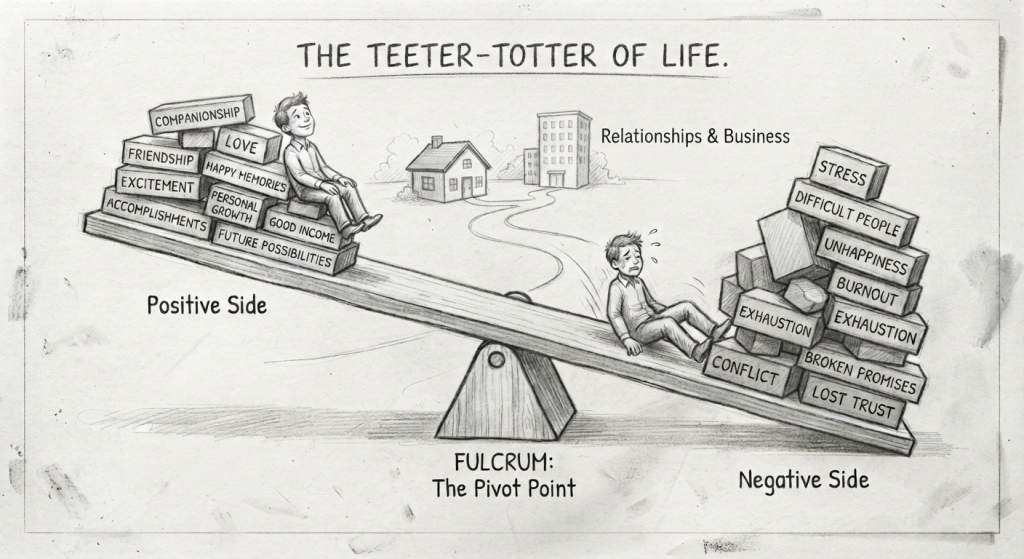
I believe the answer can be understood by imagining life as a teeter-totter.
Imagine that every relationship, job, or business is essentially a large teeter-totter with a fulcrum the pivot point in the middle.
On one end are all the things you enjoy. On the other end are the things you don’t enjoy.
At the beginning of most new situations, I believe the majority of us naturally sit on the positive side of the teeter-totter. We’re excited. We’re optimistic. We’re looking forward to what’s ahead.
The negatives may already exist, but they don’t carry enough weight to outweigh everything we enjoy about the new experience. And then something begins to happen. Over time, the weights change.
Sometimes the negative side never becomes heavy enough to outweigh the positive side. We find ways to remove the negative weight, adapt to it, or simply accept it as part of the experience.
But sometimes the negative weight continues to accumulate. One problem becomes another. One difficult relationship becomes another. One disappointment gets stacked on top of another. Eventually, the negative side begins to outweigh the positive. And we start sliding down the teeter-totter toward the other side.
Why We Stay
Here’s where things get interesting. The longer we sit on the negative side and allow those negative weights to accumulate, the more unhappy we become and the more likely we are to eventually divorce ourselves from the very thing we once enjoyed. Yet so many of us continue sitting there.
Why?
Because we tell ourselves stories.
“The money is too good.”
“Where will I find another opportunity like this?”
“Maybe things will get better.”
“I’ve invested too much to leave now.”
“It wasn’t always like this.”
And perhaps the most powerful one:
“I remember how great it used to be.”
We can become so attached to the memories of what something once was that we continue living with the agony of what it has become. Eventually, however, we reach the point where we leave. We leave the job, relationship, business and we walk away from the thing that has been weighing us down. And then something strange happens.
We begin to miss it. We wonder:
“If it was really that horrible, why do I miss it so much?”
The answer is simple. We didn’t just leave the negatives. We left the positives, too.
The teeter-totter always had two sides. Even when the negative side became unbearable, there were still things sitting on the positive side that we genuinely loved.
The Paper Cut
Here’s another way to think about it. Imagine you have a painful paper cut on one of the fingers of your right hand. It’s annoying. Every time you move paper, pick something up, or touch something with that finger, you notice it. It’s a relatively small injury, but because it is constantly being irritated, it gets your attention throughout the day.
Now imagine that you accidentally smash a finger on your left hand. Suddenly, do you remember the paper cut? Probably not. The larger pain overwhelms your awareness of the smaller one. One pain masks another.
I believe relationships, jobs, and businesses work much the same way. At any given moment, we are experiencing both positive and negative things. Sometimes the enjoyment outweighs the pain. Sometimes the pain outweighs the enjoyment. And what’s fascinating is that the difference may come down to only two, three, four, or five additional weights being placed on one side of the teeter-totter. That’s all it takes to change the balance.
Why Leaving Can Still Feel Like Grief
This brings me back to the question I started with. Why did leaving that job feel like losing a friend? Because when I left, I didn’t just leave everything I disliked. I also left everything I enjoyed. I left the parts of that experience that had genuinely brought me happiness.
Even though the negative side had eventually become heavy enough to force me out, the positive side didn’t suddenly disappear from my memory. That’s why leaving can feel like grief.
We can know something was wrong for us and still miss parts of it. Those two things can be true at the same time.
The Business Owner’s Teeter-Totter
I think this concept is especially important for business owners and perhaps for all of us. The teeter-totter is constantly moving. It doesn’t stay perfectly balanced. Over time, we find ways to remove negative weight.
We solve a problem, hire someone, improve a process, increase profitability, resolve a conflict, or regain control of our time the negative weight becomes lighter, the positive side rises again, and that’s life. But something different happens when a business owner allows negative weight to remain on the other end for too long.
The negative side may continue to outweigh the positive, but the negative seat hasn’t quite touched the ground yet. Instead, the owner begins to slip out of the positive seat, slowly sliding toward the fulcrum.
At first, they may not even realize it’s happening. They’re still operating the business. They’re still making money. They’re still achieving things. There are still parts of what they’ve built that they love. But they’re exhausted.
Then they slide a little farther, and a little farther. Eventually, the negative weight counterbalances the positive side, and the negative seat hits the ground. That is what I call the moment of burnout. Are there still things the business owner loves about the business?
Absolutely.
But the weight has shifted so dramatically that the pain now outweighs the enjoyment. Eventually, they can no longer feel the positives. They can only feel the negatives.
The Vulnerable Moment
And this is where I believe a business owner can become especially vulnerable to the opinions and wishes of others. “Sell the company.” “Realize your wealth now before it disappears.” “You’ll never get another chance.” “You’ve worked hard enough.”
Those statements may be completely rational. They may even be good advice. But there is something important we need to understand before acting on them: Burnout changes the way we perceive the teeter-totter.
When we’re sitting on the negative side, we can become convinced that the only way to stop the pain is to leave the teeter-totter altogether. And sometimes, leaving is exactly the right decision.
But sometimes, the answer isn’t selling the entire business it’s removing the negative weight. Sometimes it means changing the people, changing the structure, changing our role, or changing the way the business operates.
Sometimes we don’t need a new teeter-totter. We simply need to re-balance the one we’re already on.
And this is where the conversation gets really interesting. Because what happens when a business owner is sitting on the negative side, burned out and exhausted, and someone comes along and says:
“You should sell.”
Here’s a hypothetical conversation that shows how this could play out.
The Conversation
M&A Advisor: You look exhausted.
Business Owner: I am. I’ve been carrying this company for twenty years. Lately, I’m not sure how much longer I want to do it.
M&A Advisor: That’s exactly why we should talk about selling.
Business Owner: Selling? I’ve never said I wanted to sell.
M&A Advisor: You don’t have to say it. Burnout has a way of telling you things before you’re ready to admit them. You’ve worked hard enough. Isn’t it time to enjoy what you’ve built?
Business Owner: Maybe. But I could change the management team. Or step back from day-to-day operations.
M&A Advisor: You could. But why risk it? You have an opportunity right now to turn all of this into cash. Markets change. Competitors change. One bad year could reduce what your company is worth.
Business Owner: But the business is still performing well.
M&A Advisor: Exactly. That’s why now is the perfect time to sell. Buyers pay the most when a company looks strong. If you wait until there’s a problem, they’ll know you need to sell and your negotiating position disappears.
Business Owner: So you’re saying I might regret waiting?
M&A Advisor: I’m saying you may never get another opportunity like this one.
Business Owner: But what if I don’t actually want to sell?
M&A Advisor: I think you’re confusing wanting to leave the stress with wanting to keep the company. Those are two very different things.
Business Owner: Maybe I could keep the company and remove the things causing the stress.
M&A Advisor: Of course you could. But that takes time, uncertainty, and more work. Selling gives you something much simpler: certainty.
Business Owner: Certainty for whom?
M&A Advisor: For you.
Business Owner: Or for the buyer?
M&A Advisor: (pauses) The buyer gets a great company. You get your life back. Seems like a pretty good trade.
Business Owner: Maybe. But I think I need to figure out whether I want to sell the company or whether I just want to stop carrying it the way I’ve been carrying it.
Conversations like the example above are happening every day, and they have been for years. An owner is considering leaving, and someone is always trying to convince them to leave sooner rather than later.
My focus is simply on trying to decrease the statistic that 75% of business owners regret the decision to sell their company two years post transaction. I don’t care if you sell after five years or 50 years, as long as it was the best decision you made and you are happy with that decision.
I believe the concept illustrated by the teeter-totter example is one of those universal principles that can help business owners decrease that statistic if applied.
However, I do recognize that the teeter-totter principle does not explain all the reasons why many business owners experience regret after selling their companies. It does, however, offer another perspective on why they experience regret and point to possible solutions for overcoming it.
Just one more tool, among many, to help get the job done.
Thanks for reading and I look forward to your comments.